
Let me tell you about Ramesh.
He runs a dental clinic in Koramangala, Bengaluru. Good doctor. Great reviews from word-of-mouth patients. A website his nephew built in 2019. He spent ₹40,000 with an SEO agency last year.
Today, if you type “dentist in Koramangala” into Google, you will not find him. You’ll find three competitors in the Map Pack, a fourth one ranking #1 organically, and Ramesh sitting somewhere on page two, invisible to the 75% of people who never scroll past the first page, a figure consistently reported by HubSpot and Search Engine Journal.
When he asked the agency what they’d actually done, he got a PDF report full of terms he didn’t understand. “Citation building.” “On-page optimization.” “GBP signals.”
He had paid for local SEO services. He just had no idea what those words meant, or whether the work had been done properly.
This article fixes that.
If you’re a business owner in India considering local SEO, whether you run a law firm in Connaught Place, a salon in Bandra, or a restaurant in T. Nagar, here is the complete, honest picture of every service a local SEO agency should be delivering for you. What each service is. Why does it matter? What good execution actually looks like.
What Services Does a Local SEO Agency Provide?
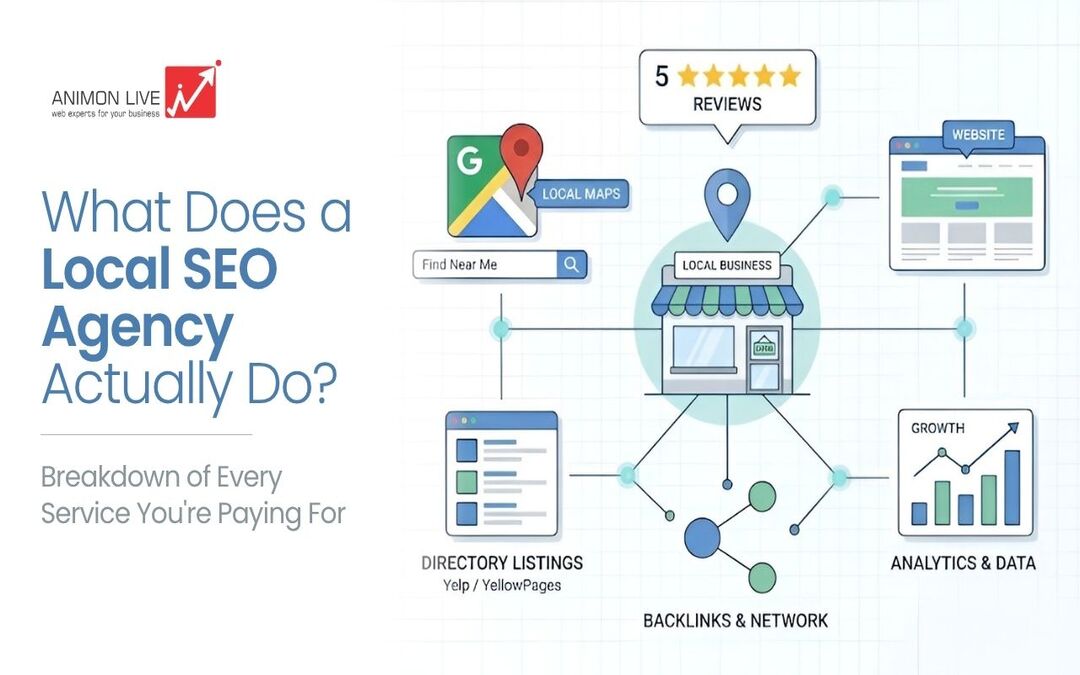
Local SEO is not one thing. It is a system, several interconnected services that work together to tell Google: this business is real, it’s relevant, and it deserves to be shown to nearby searchers.
Here’s a quick overview of the full local SEO services list before we go deep on each:
| Service | What It Achieves |
|---|---|
| Google Business Profile (GBP) Optimization | Appears in Maps and the Local 3-Pack |
| Local Citation Building & NAP Consistency | Credibility signals across the web |
| Local Keyword Research & On-Page Optimization | Organic rankings for geo-targeted terms |
| Review Generation & Reputation Management | Trust, conversion, and ranking signals |
| Local Link Building | Domain authority from nearby sources |
| GBP Post Management & Ongoing Reporting | Ongoing engagement and performance tracking |
Now let’s get into the actual work.
Google Business Profile Optimization
Your Google Business Profile, formerly called Google My Business, or GMB, is the single most important asset in local SEO services. Full stop.
It’s the box that appears on the right side of Google Search when someone looks up your business by name. More importantly, it’s what puts you in the Local 3-Pack: those three map-pinned businesses that appear at the very top of search results when someone types “orthopedic clinic near me” or “chartered accountant in Andheri.”
You already know how this works because you do it yourself. When you search for a restaurant or a plumber on your phone, you pick from the first three map results. Most people never scroll further. According to Backlinko, 42% of all local searches result in a click on one of those three Map Pack results. If you’re not in it, you’re largely invisible.
What does GBP optimization actually involve?
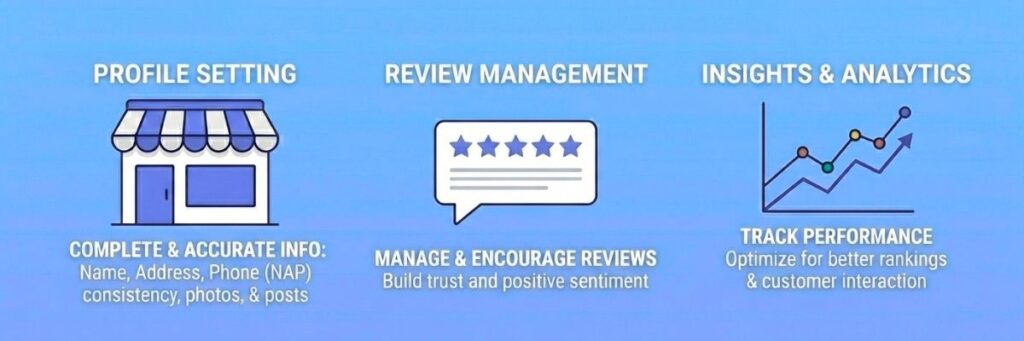
A good agency starts by claiming and verifying your profile if it hasn’t been done, a process Google takes seriously. They then complete every section with precision:
- Business name, address, phone number (NAP): Exactly as it appears everywhere else online. No abbreviations, no variations. Consistency matters deeply here.
- Business categories: Most businesses choose only one primary category. A well-optimized profile uses the primary category strategically and adds relevant secondary categories. A general physician clinic, for example, would not just list “doctor”, they’d add categories for specific services they offer.
- Business description: A keyword-rich, naturally written description of what you do and where you serve. Not stuffed. Not robotic.
- Photos and videos: According to Google’s own published data, profiles with photos receive 42% more direction requests and 35% more website clicks than those without. An agency will upload high-quality images of your exterior (so customers can recognize your location), interior, team, and products or services.
- Service areas and hours: Including holiday hours and special hours, updated regularly.
- Q&A section: Many businesses ignore this. Smart agencies proactively add frequently asked questions and answer them, controlling the narrative before customers have to ask.
- Attributes: Things like “wheelchair accessible,” “accepts UPI,” “free Wi-Fi,” and “women-led business.” These small details filter your business into more specific searches.
What’s the expected outcome?
When GBP is set up correctly and fully optimized, you become eligible to appear in the 3-Pack for relevant local searches. You won’t rank there instantly, it takes time and the other signals we’ll discuss below, but without a complete profile, you simply cannot compete.
Local Citation Building and NAP Consistency
Most business owners never stop to ask: how does Google actually know your business is real?
Anyone can create a website and claim to be a business. Google needs trust signals from across the internet before it starts sending customers your way. One of the oldest and most reliable of those signals is citations.
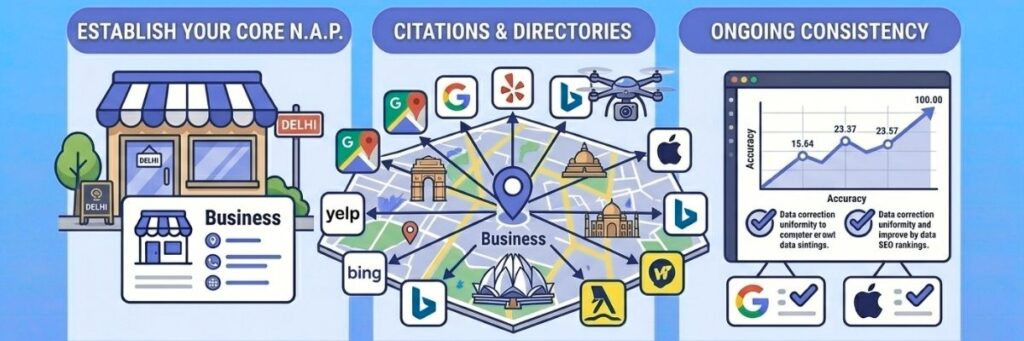
A citation is any online mention of your business’s name, address, and phone number (NAP). It doesn’t have to include a link. It just has to exist, consistently, across multiple authoritative websites.
Why does consistency matter so much?
Say Google finds 40 mentions of your business across the web. Thirty of them say your phone number is 98XXXXXX10. Five say it’s 98XXXXXX01, an old number you changed two years ago. Three list your address with “2nd Floor” and two don’t. Two use “Dr. Sharma’s Clinic” and the rest say “Dr. R. Sharma Clinic.”
To a human, that’s minor variation. To Google’s algorithm, it looks like uncertainty. Is this one business or multiple? Is this information reliable enough to show to users?
NAP inconsistency silently kills local rankings. Many businesses in India, especially those that have changed office locations or phone numbers over the years, suffer from this problem without ever knowing it.
Where should Indian businesses be listed?
A proper citation-building strategy for India covers three tiers:
Tier 1, Major aggregators and platforms:
- Justdial (still one of India’s most visited local directories)
- Sulekha
- IndiaMART (especially for B2B businesses)
- IndiaBizInfo
- TradeIndia
- Google Maps (technically a citation platform)
- Bing Places
- Apple Maps
Tier 2, Industry-specific directories: A dentist should be listed on Practo and Lybrate. A lawyer on Vakilsearch. A chartered accountant in CAclubindia. A hotel on MakeMyTrip and Goibibo. These niche citations carry more weight than general directories because they’re contextually relevant.
Tier 3, Hyperlocal and regional directories: City-specific portals, local newspapers that list businesses, regional association websites, and chamber of commerce listings. For a business in Pune, being listed on a Pune-specific business portal carries more local relevance than a generic national directory.
What does a good agency actually do here?
They begin with a citation audit, finding every existing mention of your business and correcting inconsistencies. Only then do they build new citations. Building on a dirty foundation doesn’t work. After cleanup, they systematically submit your NAP to the right directories, track submissions, and provide documentation.
This is not glamorous work. It is tedious, detail-oriented work. But it’s the kind of work that pays off in local ranking, and it’s one of the services most agencies rush through or do poorly.
Local Keyword Research and On-Page Optimization
Citations and GBP alone won’t rank you for every type of search. Your website has to do its share of the work too.
When someone in Chennai types “best interior designer for 2BHK flat” into Google, they’re not looking at the Map Pack. They’re scrolling through the organic results below it. To appear there, your website needs to be optimized around the specific phrases local customers are actually using.
Local keyword research is different from regular keyword research
General keyword research asks: “what do people search for in relation to this topic?”
Local keyword research asks: “what do people in this city, this neighbourhood, this context search for, and how do I reach them at that exact moment?”
The difference is precision. Consider these variations:
- “pest control service” vs. “pest control service in Indiranagar Bangalore”
- “CA firm” vs. “GST filing CA near me Pune”
- “wedding photographer” vs. “candid wedding photographer South Delhi under 1 lakh”
Each of those long-tail, location-specific variations represents a real person with real buying intent. A good local SEO agency builds a keyword map across these variations, organized by search volume, competition level, and commercial intent.
What does on-page optimization involve?
Once the keyword research is complete, the agency works on your website’s pages:
Location Pages: If you serve multiple areas or have multiple branches, each location deserves its own dedicated page, not a generic “Contact Us” page with all addresses lumped together. A separate page for your “Gurgaon branch” and your “Noida branch” lets each page rank independently for its own set of local searches.
Title Tags and Meta Descriptions: The words that appear in the search result snippet should include your primary keyword and location. Not stuffed, written for humans, not bots.
Header structure: Your H1, H2s, and body copy should weave in location signals naturally. “We’ve been helping businesses in Hyderabad” is better than a robotic injection of keywords.
Schema markup (LocalBusiness): This is code added to your website that speaks directly to search engines. It tells Google formally: here is my business name, here is my address, here are my opening hours, here are the services I offer. Google uses this structured data to better understand your content, and increasingly, to generate AI Overview answers. In India, where businesses often serve multiple languages and localities, schema markup is especially underused and therefore especially powerful when implemented correctly.
Embedded Google Maps: A map embed on your contact page sends an additional location signal. It also improves user experience for customers trying to find you.Expected outcome: Improved rankings in organic (non-map) local search results. More traffic from people who are genuinely in your service area and looking for exactly what you offer.
Online Reputation Management
Most agencies won’t say this upfront, but reviews can override everything else.
You can have the most perfectly optimized Google Business Profile in your city. You can have 500 citations and a beautifully structured website with schema markup. A competitor with 200 genuine five-star reviews will still rank above you.
Reviews are that powerful.
Google treats reviews as both a trust signal and a relevance signal. More reviews, and more recent reviews, tell Google that your business is active, credible, and well-regarded. For customers, reviews are the last piece of persuasion before they click “call.”
You already do this yourself. The last time you chose a restaurant, a mechanic, or a doctor you’d never visited before, you checked the rating. You read a few reviews. Everyone does.
What does Online Review Generation actually involve?
A legitimate agency helps you build a system for consistently asking happy customers to leave reviews. This might include:
- SMS or WhatsApp messages sent after a service is completed, with a direct link to your Google review page
- QR codes at your counter or on receipts
- Follow-up email sequences for service-based businesses
- Staff training on how and when to ask for reviews (this matters more than most people realize, how you ask significantly affects how many customers follow through)
One critical note: Google’s own review policies, which apply globally, including in India, prohibit offering incentives for reviews or asking for a specific star rating. You can ask satisfied customers to share their experience. That’s it. Agencies that promise to “get you 50 five-star reviews in a month” are either offering fake reviews (which Google actively detects and removes) or violating platform policies. Both will hurt you.
Reputation management: responding to reviews
Generating reviews is half the job. Responding to them is equally important, and it’s where most Indian businesses fall short.
When you respond to a review, Google sees an active, engaged business. When customers read your response to a one-star review, and see that you handled it professionally and with genuine care, many of them will trust you more than if you had no negative reviews at all. Nobody believes a business with 50 reviews all rated 5 stars.
A good agency manages this for you: drafting responses, flagging spam or fake competitor reviews for removal, and maintaining a consistent tone across your profile.
Local Link Building Strategies
If citations are like getting your name in a directory, backlinks are like getting a recommendation from someone your city trusts.
A backlink is when another website links to yours. In local SEO, links from locally relevant and authoritative sources carry significant weight. A mention and link from a well-regarded Bengaluru food blog carries more local SEO value than a generic link from a directory no one has heard of.
What does local link building look like in practice?
Local press and media: Getting featured in a regional newspaper’s website, a city-specific digital publication, or an industry journal establishes both authority and local relevance. A good agency will have relationships with local journalists or will pitch your story as a news angle. Opened a new branch? Launched an initiative? Had an interesting business milestone? These are all potential stories.
Local business associations and chambers of commerce: Organizations like FICCI, CII, NASSCOM (for tech), or city-specific chambers often list member businesses on their websites. These are high-authority local links that many businesses overlook.
Event sponsorships and community involvement: Sponsoring a local event, a school cricket match, a cultural festival, a neighbourhood cleanup, often results in your business being mentioned (and linked) on event pages, community websites, or social media accounts. The link is a side effect of genuinely being present in your community.
Partnerships with complementary businesses: A wedding photographer can get links from wedding venues, caterers, and florists in their city. A paediatric dentist can get links from local schools and parenting groups. These contextual relationships are natural, relevant, and powerful.
Guest content on local publications: Writing a useful article for a Hyderabad business journal, a regional lifestyle blog, or a city-specific news portal builds both authority and visibility.
Citations are about consistency and presence. Links are about authority and recommendation. Both matter. They serve different parts of Google’s algorithm.
Ongoing GBP Management and Reporting
This is where most agencies, and most businesses, let things slide.
Local SEO is not a one-time project. It’s a continuous practice. Your Google Business Profile rewards ongoing activity and goes quiet when you ignore it.
GBP Post Management
Google Posts are updates you can publish directly to your Business Profile. They appear in your listing on Google Search and Maps. Few businesses in India use them well.
A well-managed GBP will have regular posts covering:
- New offers or promotions (“20% off dental cleaning this month”)
- New services or products you’ve added
- Business updates (“We’ve extended our hours”)
- Events you’re hosting
- Seasonal content relevant to your audience
Google uses engagement signals. A profile that publishes regular, relevant posts signals an active business. It also gives customers a reason to interact, and interaction (clicks, calls, direction requests) is itself a ranking factor.
Monitoring and responding to Q&A
New questions appear in your GBP without warning. Unanswered questions make your business look unresponsive. An agency actively monitoring your profile catches these and answers them promptly, or escalates questions you need to answer yourself.
Photo and update management
New photos added regularly keep your profile fresh. Outdated photos of a renovation that happened three years ago, or a menu that’s no longer current, actively hurt conversions. A managed profile stays current.
Monthly Reporting: What Should You Actually Receive?
This is where many Indian businesses have been burned. They receive a PDF with graphs they don’t understand, full of metrics that don’t connect to business outcomes.
A genuinely good local SEO service report should tell you:
- GBP Performance: How many times did your profile appear in search? How many calls came directly from Google? How many people clicked directions? How many people visited your website from your GBP?
- Keyword ranking movement: Which local keywords moved up? Which ones still need work? Are you in the 3-Pack for your most important terms?
- Citation health: How many citations were built or corrected this month?
- Review activity: New reviews received, your average rating trend, response rate.
- Website traffic from local searches: Organic visits from people in your target area, and whether they converted (called, filled a form, booked an appointment).
Every number in a good report tells a story. If your GBP calls went from 45 in January to 12 in March, something changed, and your agency should be explaining what happened and what they’re doing about it.
Putting It All Together: What to Expect from Local SEO Services in India
Local SEO is not magic. It is a method.
When all these services work together, a fully optimized GBP, consistent citations across Justdial, Sulekha, IndiaMART and dozens of others, a website with clean on-page signals and schema markup, a steady stream of genuine reviews, local links from credible sources, and consistent GBP activity, Google’s algorithm starts treating your business as the most trustworthy, most relevant option for nearby searchers.
That is when the phone starts ringing with strangers. Not referrals. Not word-of-mouth. People who found you on Google because you showed up before your competitors did.
For businesses in competitive cities, Mumbai, Delhi, Bengaluru, Hyderabad, Pune, Chennai, that typically takes three to six months before you see real movement. In smaller tier-2 and tier-3 cities, results come faster because the competition is thinner and the local SEO landscape is less crowded.
The businesses that win local search are not always the biggest or the best-funded. They’re the ones who did the fundamentals properly, consistently, and patiently.
Now you know what those fundamentals are. The next time an agency sends you a proposal, ask them exactly which of these services they’re delivering, how they’ll measure it, and how they’ll show you the results.
Ramesh deserved to know. So do you.
Related Blogs:
- Complete Guide to Local SEO Packages in India
- Google Business Profile Optimization
- Local SEO Packages in India: What Do They Cost?